Choosing the right size coffee table can feel overwhelming. You walk into a furniture store or browse online, and the options are endless—round, square, oversized, compact. The decision is not just about what you like; it’s about what actually fits your space and works with your lifestyle.
If you’ve ever bought a coffee table that looked perfect online but awkward in your living room, you’re not alone. Getting the size right is crucial for both function and style. In this guide, you’ll learn exactly how to pick the best size coffee table for your home, including practical tips, common mistakes, and expert insights that most people miss.
Why Coffee Table Size Matters
A coffee table is more than just a place for your remote or coffee cup. It’s the centerpiece of your living room. The right size improves traffic flow, anchors your seating area, and offers the right amount of surface space. The wrong size can make the room feel cramped or empty. For example, a table that’s too small can look lost in a large room, while an oversized table can make it hard to walk around or even use your sofa comfortably. Proportions matter more than you might think.
Measuring Your Space
Before you even look at styles, you need to measure your space. It’s not just about the table itself, but the area around it.
- Measure your seating area: This usually means the space between your sofa and chairs or other seating.
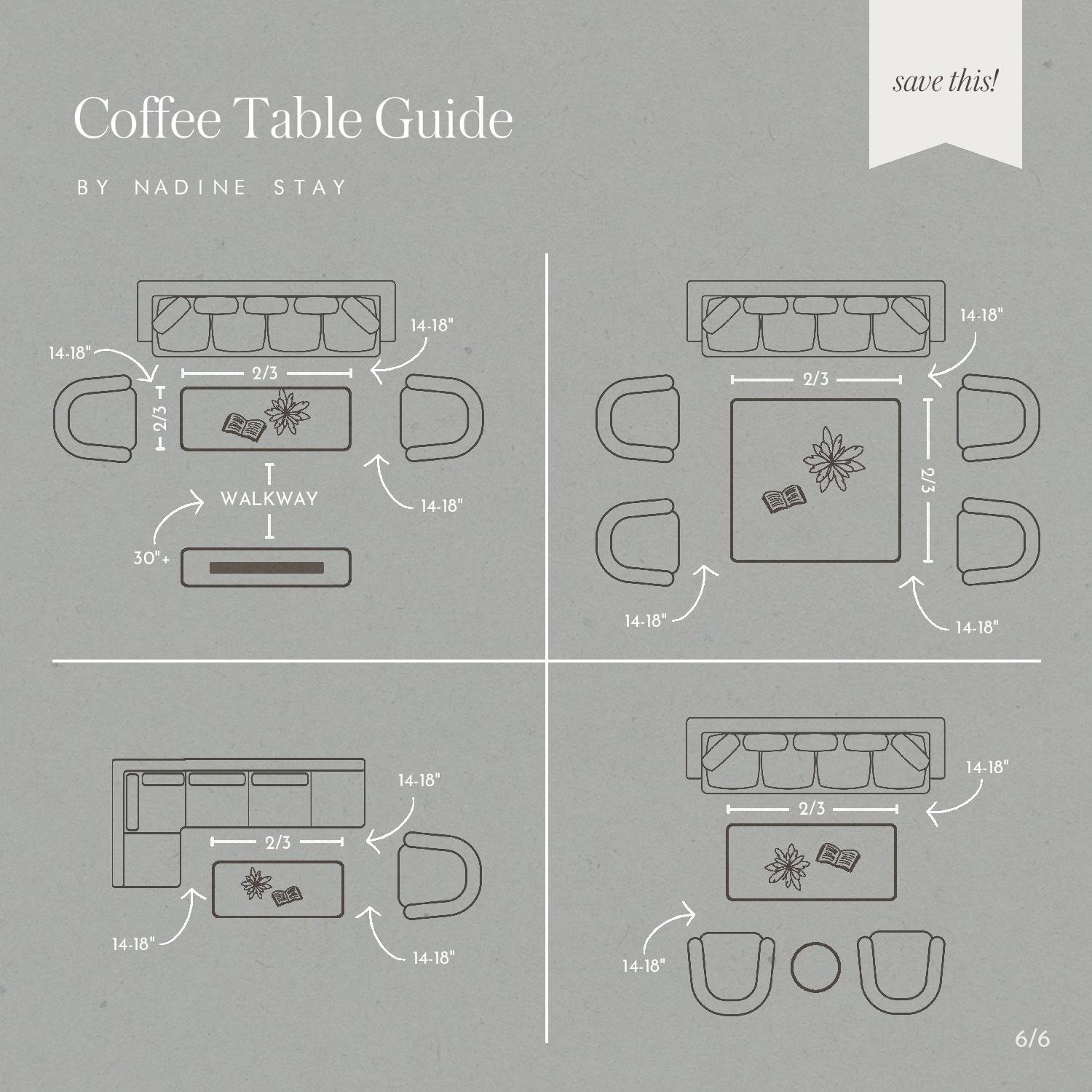
- Allow for walking space: You’ll need at least 16-18 inches between the edge of the coffee table and your sofa or chairs for easy movement.
- Check the room shape: A long, narrow room may need a rectangular table; a square room might suit a round or square table.
Pro tip: Use painter’s tape to mark out the size of the coffee table on your floor. This gives you a real sense of scale before you buy.
Standard Coffee Table Dimensions
Coffee tables come in a wide range of sizes, but there are some standard dimensions that work for most homes.
| Shape | Length | Width | Height |
|---|---|---|---|
| Rectangular | 40-50 inches | 20-30 inches | 16-18 inches |
| Square | 30-40 inches | 30-40 inches | 16-18 inches |
| Round | 30-48 inches (diameter) | N/A | 16-18 inches |
| Oval | 40-50 inches | 20-30 inches | 16-18 inches |
These are just starting points. The best size for you depends on your room and furniture.
How To Choose The Right Length
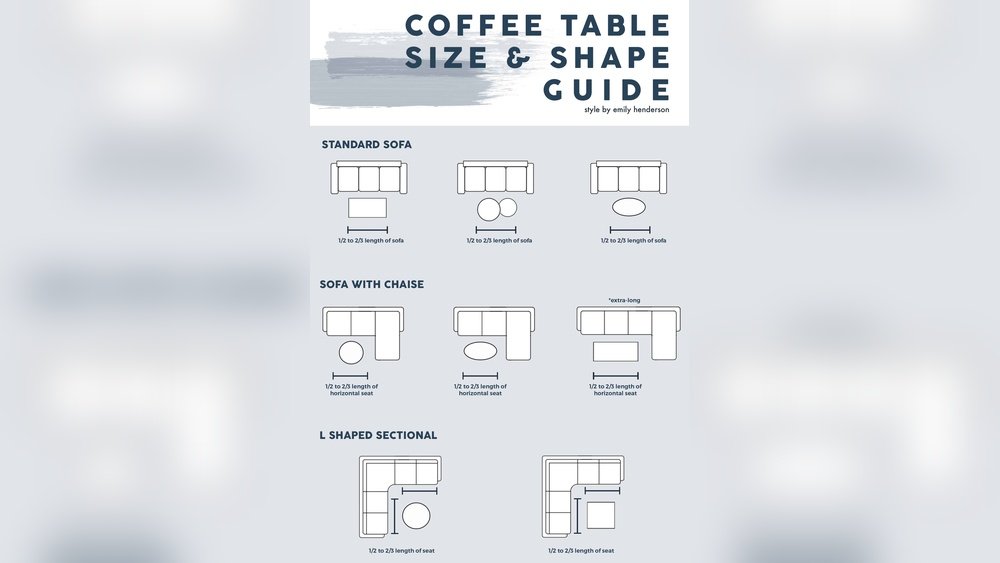
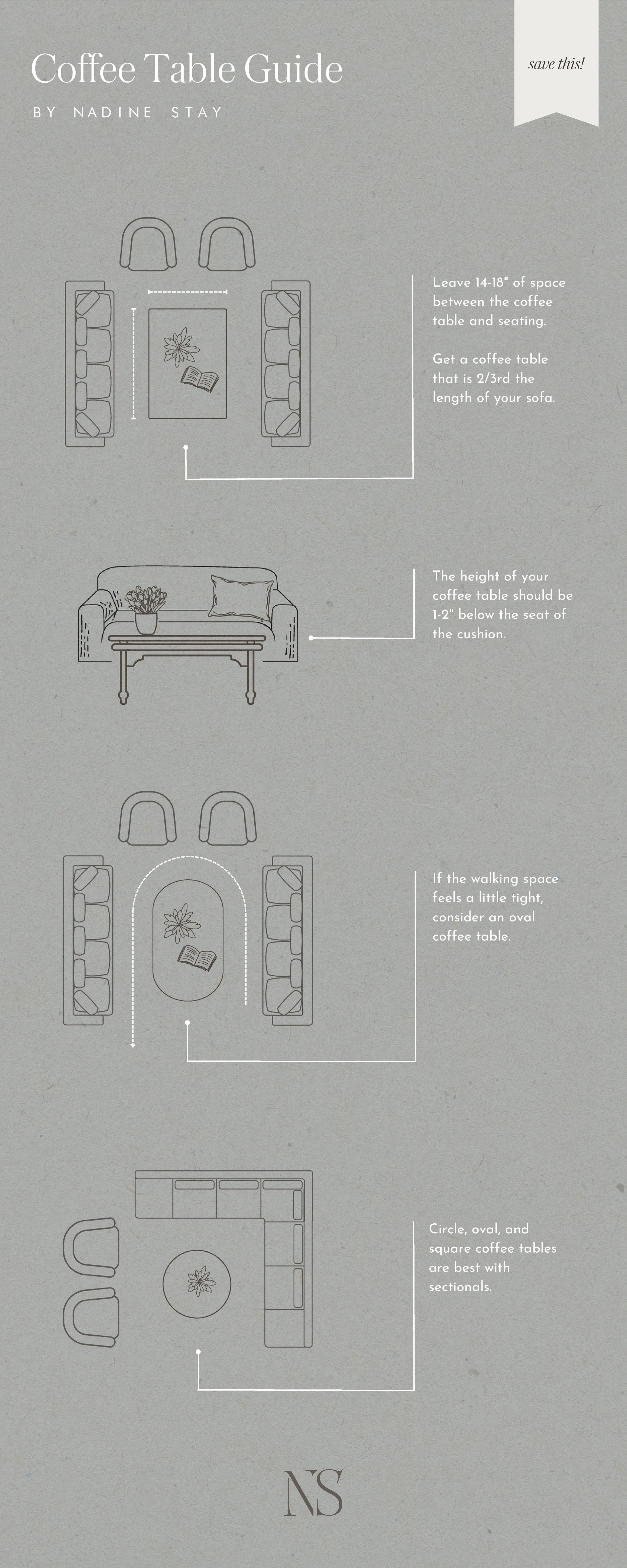
The most important rule: your coffee table should be about two-thirds the length of your sofa. For example, if your sofa is 90 inches long, your coffee table should be around 60 inches.
Why two-thirds? This keeps the table looking balanced and easy to reach from all seats. Too short, and it will look awkward. Too long, and it dominates the space.
If you have a sectional, measure the longest side and apply the same rule. For L-shaped sectionals, sometimes two smaller tables or a set of nesting tables fit better than one large one.
How To Choose The Right Height
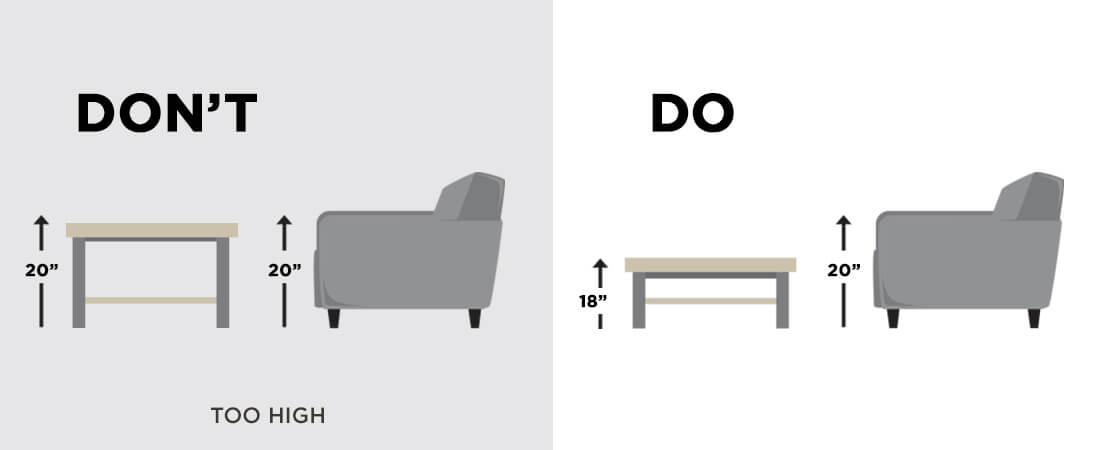
Most coffee tables are between 16 and 18 inches tall. The golden rule is this: your coffee table should be the same height or 1-2 inches lower than the seat of your sofa.
If your sofa seat is 18 inches tall, your coffee table should be 16-18 inches. This makes it easy to set down a drink or rest your feet. A table that’s too high feels awkward, and one that’s too low is uncomfortable to use.
Non-obvious insight: If you like to eat or work at your coffee table, consider a slightly taller “lift-top” table. These can double as a small desk or dining space for casual meals.
How To Choose The Right Width And Shape
The width of your coffee table depends on how much space you have. Most are around 20 to 30 inches wide. Make sure you leave enough space to walk around all sides—ideally 16-18 inches between the table and the sofa or chairs.
Shape tips:
- Rectangular tables work best with standard sofas and long rooms.
- Round tables are great for small spaces or families with young children (no sharp corners).
- Square tables fit well with large sectionals or square seating areas.
- Oval tables combine the benefits of rectangular and round—more space, but no sharp corners.
Matching Coffee Table Size To Room Size
Your living room’s size and layout matter as much as your sofa.
Small Living Rooms
For small rooms, choose a compact table (30-36 inches long). Round or oval tables are often best because they allow easier movement.
Medium Living Rooms
A standard table (40-48 inches long) works for most average-sized rooms. Rectangular or square shapes usually fit well.
Large Living Rooms
If you have a big space, you can go bigger—up to 54 inches or more. Or, use two smaller tables side by side for flexibility. Oversized coffee tables can double as extra seating or storage.
Coffee Table Size Vs. Sofa Size
Here’s a quick comparison to help you match your coffee table to your sofa size:
| Sofa Length | Recommended Coffee Table Length |
|---|---|
| 60 inches | 40 inches |
| 72 inches | 48 inches |
| 84 inches | 56 inches |
| 96 inches | 64 inches |
Pro tip: Always round down if you’re in between sizes. It’s better for a table to be a little too small than too large.
Coffee Table Size For Different Sofa Types
Not all sofas are the same. Here’s how coffee table size works with different styles:
Standard Sofa
Go with the two-thirds rule (see above). Most standard sofas pair well with a table around 40-48 inches long.
Sectional Sofa
Sectionals can be tricky. For U-shaped sectionals, a square or round table usually works best. For L-shaped sectionals, a rectangular table often fits better, but make sure everyone can reach the table.
Loveseat
Loveseats are short (about 52-66 inches). Look for a small table, around 30-36 inches long.
Chaise Lounge
If you have a chaise, consider a smaller, round table placed near the middle. You might also use a side table instead of a coffee table.
How Much Space Should Be Around The Coffee Table?
You need space to walk and move around your table.
- Leave 16-18 inches between the table and your sofa or chairs. This is enough for most people to pass by comfortably.
- If you have kids or need more room, go up to 20-24 inches, but don’t go less than 14 inches.
- For large rooms, don’t let the table “float” too far from the seating, or it will feel disconnected.
Non-obvious insight: In open-plan spaces, use your coffee table to help define the seating area. The right size can make a “zone” feel cozy, even in a big room.
Coffee Table Size For Different Functions
How you use your coffee table affects the size you need.
For Serving And Entertaining
If you love hosting, pick a larger table (48 inches or more) with plenty of surface area for snacks and drinks.
For Storage
Choose a table with shelves or drawers, but make sure the extra storage doesn’t make it too bulky for your room.
For Family Use
For homes with kids, a round or oval table is safer and allows more movement. Avoid heavy glass tops.
For Small Apartments
Consider nesting tables or a compact, multi-purpose table that can serve as a coffee table, footrest, or extra seat.
Common Mistakes When Choosing Coffee Table Size
Many people make these mistakes when buying a coffee table:
- Ignoring proportion: A tiny table with a big sofa looks odd, and a huge table with a small sofa overwhelms the space.
- Not measuring: Guessing often leads to buying the wrong size.
- Overcrowding the room: Picking a table that’s too big for your space makes it hard to move around.
- Choosing style over function: A beautiful table that’s the wrong size isn’t useful.
- Forgetting about height: Too high or too low can make the table uncomfortable.
Avoid these mistakes by measuring carefully and thinking about how you use your space.
Visual Tricks To Make Your Coffee Table Work
Even if your room is not the perfect size, you can use some design tricks:
- Glass tops: Make a small room feel bigger since you can see through the table.
- Light colors: Light woods or white tables don’t look as “heavy” in a space.
- Open bases: Tables with open legs let light pass through, helping the room feel open.
- Multipurpose tables: Ottomans or trunks can double as coffee tables, offering both function and storage.
Coffee Table Size And Rug Size
The size of your coffee table should also work with your rug. Here’s a quick guide:
- Your coffee table should sit fully on the rug, with at least 12-18 inches of rug space around it.
- The rug should be large enough to fit all front legs of your sofa and chairs.
- Don’t choose a coffee table that’s bigger than your rug; this looks unbalanced.
How Style And Material Affect Perceived Size
Sometimes, a coffee table’s style and material can make it look bigger or smaller than it is.
- Chunky wood tables look larger than they measure.
- Metal or glass tables appear lighter and less bulky.
- Tables with storage tend to look bulkier, so consider going smaller if you choose these.
Practical tip: If you’re worried about your table looking too heavy, pick one with thin legs or a glass top.
When To Use More Than One Coffee Table
Sometimes, two tables work better than one. For example:
- In very large rooms, two smaller tables can be more flexible than one big one.
- With sectionals, a pair of round tables can fill the corner space.
- Nested tables let you expand or shrink your surface as needed.
How To Test Coffee Table Size Before You Buy
If you’re unsure, try this:
- Mark the size of the coffee table with painter’s tape on the floor.
- Place boxes or books within the outline to mimic height and width.
- Walk around, sit down, and see if it feels right.
This “test drive” can prevent costly mistakes.
Coffee Table Size Trends
Design trends can influence what size table you choose:
- Oversized tables are popular in large, open living rooms.
- Smaller, flexible tables (like nesting tables or ottomans) are trendy in apartments and small homes.
- Low, minimalist tables are common in modern and Scandinavian design.
Don’t follow trends blindly—make sure the size fits your needs.
Real-life Examples
Let’s look at three real living rooms:
Case 1: Small City Apartment
- Sofa: 68 inches
- Table: 36-inch round, 16 inches high
- Result: Fits perfectly, leaves walking space, and round shape prevents stubbed toes.
Case 2: Family Home
- Sectional: 104 inches (long side)
- Table: 48-inch square, 18 inches high, with storage shelf
- Result: Everyone can reach, and storage hides toys.
Case 3: Open-Plan Loft
- Sofa: 90 inches
- Table: Two 28-inch round tables, 16 inches high
- Result: Flexible arrangement—can push together or separate for parties.
Comparison: Coffee Table Sizes For Different Room Styles
| Room Type | Best Table Shape | Recommended Size |
|---|---|---|
| Traditional | Rectangular | 48 x 24 inches |
| Modern | Low, square or round | 36-40 inches (diameter/side) |
| Scandinavian | Round or oval | 36-48 inches (diameter/length) |
| Family Room | Oval with storage | 48 x 24 inches |
| Studio/Small Apartment | Nesting or compact | 24-36 inches |
What Size Coffee Table Should I Buy? A Quick Checklist
If you want a quick reference, ask yourself:
- Is the length about two-thirds of my sofa?
- Is the height the same or 1-2 inches lower than my sofa seat?
- Can I leave 16-18 inches of space all around?
- Does the table fit my needs (storage, surface area, safety)?
- Does the style and material suit my room size?
If you answer “yes” to these, you’re on the right track.
When In Doubt, Go Slightly Smaller
If you’re stuck between two sizes, pick the smaller one. It’s easier to add side tables or move things around than to live with a table that’s too big.
Where To Find More Advice
For more guidance on furniture sizing, you can check out resources like Architectural Digest. They offer expert tips and visuals that can help you plan your space.
Frequently Asked Questions
What Is The Ideal Distance Between A Coffee Table And A Sofa?
The best distance is 16-18 inches. This allows you to reach the table easily without stretching, and gives enough room to walk around. If space is tight, you can go down to 14 inches, but less than that makes moving difficult.
Can My Coffee Table Be Taller Than My Sofa Seat?
It’s not recommended. A coffee table should be the same height or up to 2 inches lower than your sofa seat. Taller tables can be uncomfortable and look awkward. The only exception is if you need a “lift-top” table for working or eating.
What Shape Coffee Table Is Safest For Families With Kids?
Round or oval tables are best for families with children. They have no sharp corners, so there’s less risk of bumps and injuries. Choose sturdy materials and avoid heavy glass if safety is a concern.
Is It Okay For A Coffee Table To Be Smaller Than Two-thirds The Sofa Length?
It’s possible, but aim for at least half the sofa’s length. Anything smaller can look out of place and may not be useful. If your table is short, add side tables or use nesting tables to increase surface space.
Do I Need A Coffee Table At All?
Not always! Some people prefer ottomans, poufs, or several side tables instead of a traditional coffee table. The main thing is that you have a place to set things down and that your space feels balanced.
Finding the right size coffee table isn’t just a matter of taste—it’s a balance of function, comfort, and design. When you measure carefully and follow these guidelines, your coffee table will fit perfectly and make your living room more welcoming and useful.